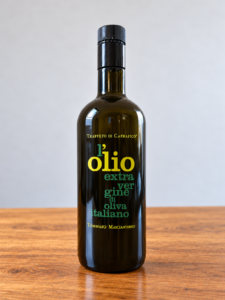
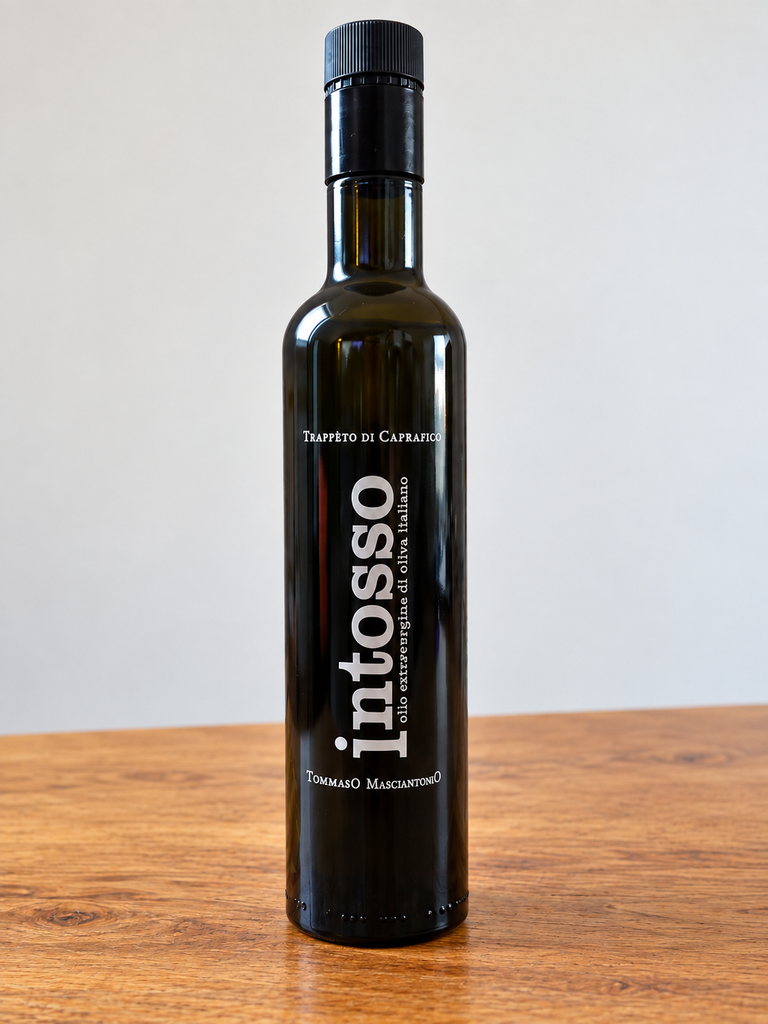
Intosso · Abruzzo, Italy · Harvest 2025/2026
Tasted by RUANO: 25 September 2026
For our first RUANO oil Tasting, we are tasting a monocultivar Intosso from Trappeto di Caprafico in Abruzzo. Intosso is an old local variety with an interesting history, and this bottle gave us the opportunity to explore both the cultivar itself and the character it can express in the glass.
Want to see how this oil compares with the others we’ve tasted? Compare the Spiderwebs of all the oils we have tasted.
The Oil
Producer: Trappeto di Caprafico
Oil: Intosso
Cultivar: Intosso
Origin: Abruzzo, Italy
Harvest: 2025/2026
Tasted: 25 September 2026
Intosso: an ancient olive variety from Abruzzo
Intosso is an olive variety found mainly in the province of Chieti, particularly in the inland areas and around the foothills of the Maiella, although it is also grown in the province of Pescara.
Intosso olives are medium to large, oval and slightly elongated, with a small point at one end. Traditionally, they have been used both as table olives and for producing olive oil.
Before they can be eaten as table olives, however, they need to be debittered. There are different ways of doing this. Today, olives may be treated using water and brine, or with alkaline solutions such as caustic soda.
In the Abruzzo tradition, another method involved an alkaline solution made from wood ash and water, often known as liscivia, or lye.
This treatment reduces the olive’s naturally intense bitterness. And this old practice seems to be where the curious name Intosso comes from. In his Vocabolario Abruzzese, published in 1880, the linguist Gennaro Finamore described the olives, once sweetened, as “’ndosse”, explaining that they were “curate nel ranno e poi nell’acqua pura” — treated in the traditional alkaline solution and then in fresh water. In other words, the olives had lost much of their bitterness and had become far more pleasant to eat. It is from this old dialect word that the name we use for the cultivar today, Intosso, is thought to derive.
For an olive grower interested in producing oil, however, Intosso has never been the most convenient variety. The trees begin producing relatively early, but the olives have a low oil yield and production tends to be moderate and somewhat irregular. The variety is also susceptible to a number of pests and diseases that can affect the tree.
This helps explain why, over the years, many growers replaced their Intosso trees with varieties that were more productive, more resistant or simply produced a higher yield of oil. And, in one sense at least, that was a shame. Particularly in the past, the amount of oil a tree could produce, its productivity and its resistance understandably played a major part in a grower’s choices. The particular sensory qualities that the oil from an individual cultivar could offer were not necessarily the priority.
Fortunately, the renewed interest in native olive varieties means that today we can look at Intosso from a different point of view. Its relatively low yield and the greater challenges involved in growing it also help explain the higher price at which a good monocultivar Intosso is often sold.
And that brings us to the oil we tasted. With its monocultivar Intosso, Trappeto di Caprafico really manages to bring out the intense and distinctive character of this ancient Abruzzo variety.
Our sensory assessment
No sensory defects were detected in our tasting.
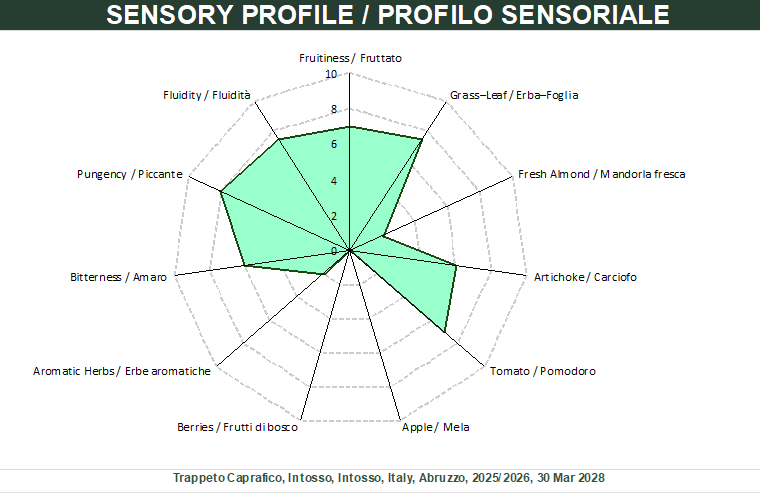
The oil presented a distinctly green fruity character, with a pronounced profile dominated by pungency, together with clear grass/leaf, tomato and artichoke notes. Bitterness was also well expressed.
More delicate notes of fresh almond, apple and aromatic herbs were present at lower intensity.
.
The RUANO Spiderweb
About our tastings
Want to know how we taste and assess each oil? Read about our tasting method, the RUANO Spiderweb and how we reach the RUANO Verdict.
All Ruano Spiderwebs. Compare the Spiderwebs of all the oils we have tasted.
The Spiderweb shows a strongly defined green profile, with pungency standing out as the most intense characteristic, accompanied by pronounced grass/leaf and tomato notes and a substantial bitter component.
Our tasting notes
The most striking feature was the intense, persistent pungency, supported by a clear but well-integrated bitterness. Overall, we found it a robust oil, with the green character carrying through strongly from the nose to the finish.
The RUANO Verdict
9/10
For us, this Intosso sets a benchmark: an oil we can return to as a reference when tasting others. Its price may put it beyond some everyday budgets, but if you have never tasted an exceptional extra virgin olive oil, it is worth experiencing at least once.
Try it on a salad, or let it take centre stage on a simple bruschetta: toasted bread and a drizzle of oil, with no other ingredients needed. Give yourself the chance to appreciate the oil itself.
We’ve managed to secure a small quantity for RUANO, and we expect it to be available in our curated shop in a couple of weeks. If you decide to try it, we’d love to hear your impressions—please let us know what you think!