Walk into almost any supermarket and you will find shelves packed with vegetable oils. Well… I tend to ignore most of them and head straight for the extra virgin olive oil.
I have already written a short article on how to choose a good olive oil, explaining some of the information we can look for on the label. The idea is to use a series of simple filters to narrow down the choice, eliminating some obvious red flags and concentrating on bottles that show signs of being a good-quality extra virgin olive oil.
But there is still a problem.
Even after applying those filters, we are usually left with quite a few oils to choose from—and often with very different prices.
Those differences can reflect real factors: the cultivar, where the olives are grown, how and when they are harvested, the extraction process, production volumes and others. But price can also be influenced by branding, fancy packaging, marketing and distribution.
So, especially when we are paying a premium price for a bottle, maybe we have often wondered… what is actually inside it?
“Which oil would you recommend?” This is probably the question I am asked most often.
Many friends have asked me for a specific name or brand. I have also had the privilege of giving short lectures on olive oil and its qualities as part of nutrition courses, and very often, at the end, the same question comes: “So, which olive oil would you actually recommend?”
Over the years, I have recommended oils that I had personally tried: some that I considered fair, some very good, and occasionally some that I thought were extraordinary
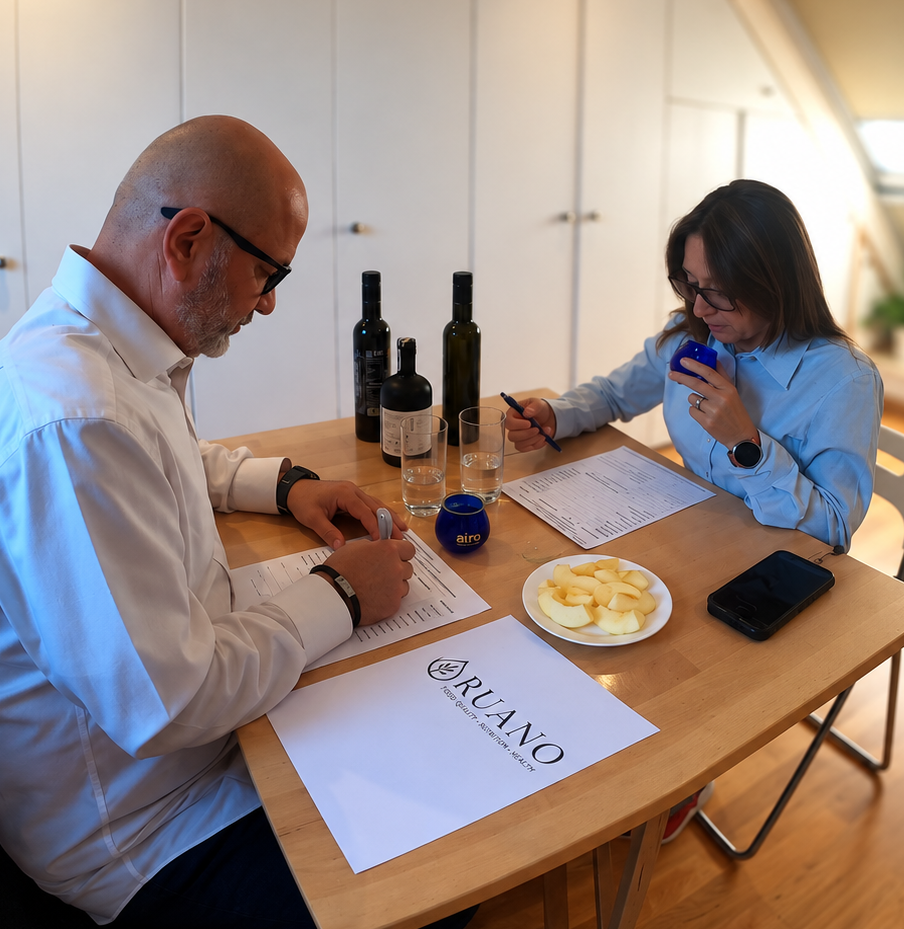
More recently, after undertaking further training in olive oil tasting and sensory assessment, Julia and I decided to do something that would be enjoyable for us and interesting and useful for some of you too.
We are going to taste different extra virgin olive oils, record their sensory characteristics and share the results here.
Not just expensive or prestigious oils
We will not focus exclusively on prestigious estate oils, specialist shops or expensive artisan bottles.
Of course, I am interested in those too, and we will certainly taste some superior oils. But I also want to look at the bottles that people actually see and buy during their weekly shopping—including oils available from mainstream supermarkets and discount retailers.
Why? Because an oil does not need to be extraordinary to be worth buying.
A reasonably priced supermarket EVOO may have a good sensory profile, the health benefits and be a good oil for everyday use. On the other hand, an expensive bottle with beautiful packaging does not guarantee an extraordinary oil.
That contrast is precisely one of the things I want this series to explore.
How will we assess the oils?
There are really three questions I want each tasting to answer.
1. Is the oil sound?
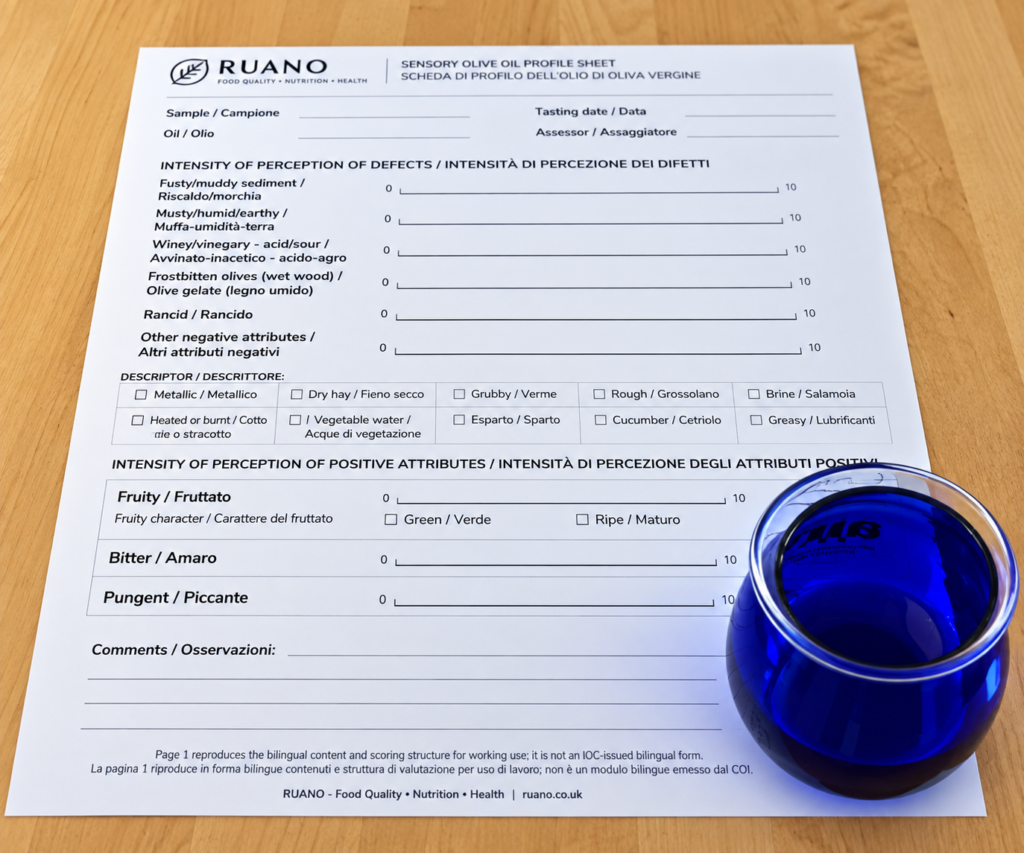
First, we look for sensory defects.
These are recognised negative organoleptic characteristics that can arise from problems with the olives, processing or storage—for example, rancid, fusty/muddy sediment (very common) or musty notes.
And yes, defects can be encountered even in a bottle labelled Extra Virgin Olive Oil.
2. What is the oil actually like?
If no defect is detected, we can start exploring the oil’s positive sensory profile.
We will consider and record 11 characteristics. These include fruitiness, bitterness and pungency, together with aromatic descriptors such as grass/leaf, fresh almond, artichoke, tomato, apple, berries and aromatic herbs, as well as fluidity.
This gives us something much more useful than simply saying that an oil is “strong”, “mild” or “nice”.
It gives the oil a sensory identity.
3. How does it work as a whole?
Intensity alone doesn’t tell us whether an oil is excellent.
We also need to consider how its characteristics work together: its balance, harmony and overall sensory impression, because two very different oils can both be excellent.
The RUANO Spiderweb
To make all of this easier to see and compare, we record the sensory characteristics on a radar diagram.
In Italy, this type of diagram is often referred to as a ragnatela—literally, a spiderweb. Once the different points are joined together, it is easy to see why.
I have created our own RUANO Spiderweb for these tastings so that, rather than trying to remember a long list of figures, you can see the character of an oil at a glance and compare its profile with another.
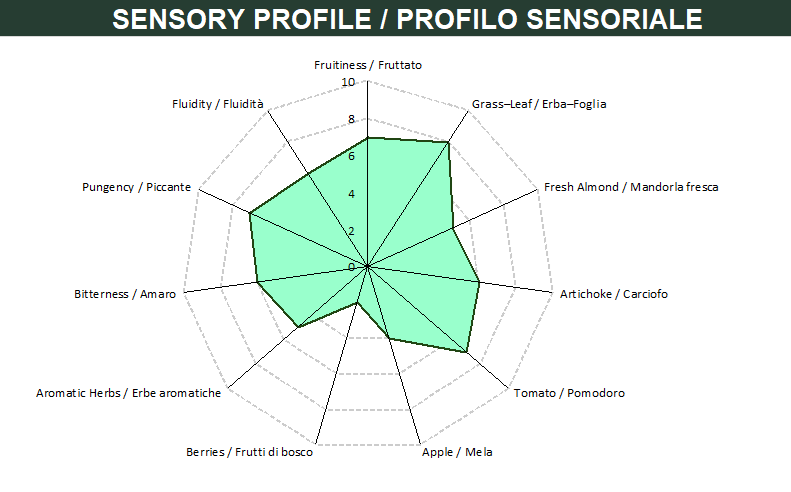
A fuller spiderweb generally tells us that the characteristics being measured are expressed with greater intensity.
Of course a bigger spiderweb does not automatically mean a better olive oil.
A robust oil with pronounced fruitiness, bitterness and pungency may create a large spiderweb. A more delicate oil may create a smaller one and yet be well balanced and of excellent quality.
At the other extreme, a very flat oil may produce a tiny spiderweb—sometimes almost a dot in the middle. That doesn’t automatically tell us why the oil is flat, but it certainly tells us that there isn’t much happening sensorially.
This is why the spiderweb should always be considered together with the complete sensory assessment.
More than simply “good” or “bad”
I don’t want these reviews to reduce an olive oil to a simple pass-or-fail judgement.
An oil can be sound and free from detectable defects, yet have a rather flat and uninteresting sensory profile.
Another may be intensely fruity, bitter and pungent.
Another may be much more delicate but balanced.
And two excellent oils produced from completely different cultivars may have very different spiderwebs.
That’s part of what makes extra virgin olive oil so interesting.
For every bottle we taste, I plan to show you the RUANO Spiderweb, our sensory observations and an overall RUANO Verdict.
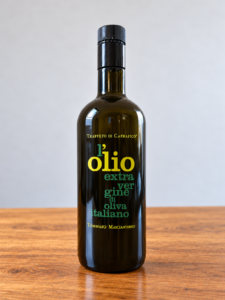
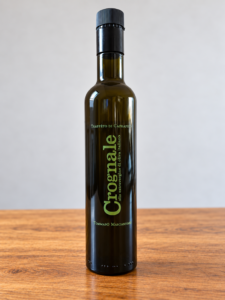
Where the information is available, I will also include details such as the producer, country and region of origin, cultivar or blend, harvest information and best-before date, together with photographs of the bottle and label.
And I will tell you when the bottle was tasted, because olive oil changes with time. A bottle from one harvest—or one that has been stored for considerably longer—may not necessarily represent the same oil you find in another year.
Sensory assessment and laboratory analysis are not the same thing
One important Note: these are independent sensory assessments carried out using our structured RUANO tasting profile. They are not intended to replace the official classification of an olive oil by a recognised sensory panel, nor chemical laboratory analysis.
Laboratory testing can tell us things that our senses cannot—for example, free acidity, peroxide value, UV absorption characteristics and, when tested, total phenolic content.
Sensory assessment tells us something different: what the oil actually presents to our senses.
Where laboratory results are available, I may include or discuss them separately.
Did we buy the bottle ourselves?
For transparency, every review will make this clear.
If we purchased the oil ourselves, we will say so. If an oil has been supplied by a producer for assessment, we will say that too.
Whether an oil has been purchased by us or supplied will not affect how it is assessed.
Occasionally, if we taste an oil that we particularly appreciate and consider worth recommending, you may also find it in the RUANO Curated Shop.
The shop is deliberately different from a conventional online store. I don’t intend to fill it with products simply for the sake of having something to sell. It will contain only a small selection of products that I have personally chosen and am happy to recommend. At times there may be only a handful of products available—and at other times, there may be nothing there at all. I’d rather have an empty shop than fill it with products I wouldn’t personally choose.
[Visit the RUANO Curated Shop →]
Is there an oil you would like us to taste?
You can become involved too!
Perhaps there is a bottle you see every week in Tesco, Sainsbury’s, Waitrose, ASDA, Aldi, Lidl or another shop, and you have often wondered whether it is worth buying.
Or perhaps you have discovered an oil from a smaller producer or a less familiar cultivar and would simply like to know what we make of it.
Send us your request, telling us the exact name of the oil and where you found it.
If we receive requests from at least five people for the same oil, we will buy a bottle, taste it and publish our assessment.
Over time, I hope this will become a little library of oils—from the ordinary to the extraordinary—that you can compare whenever you find yourself standing in front of a supermarket shelf or browsing online and wondering: “What’s really in this bottle?”