
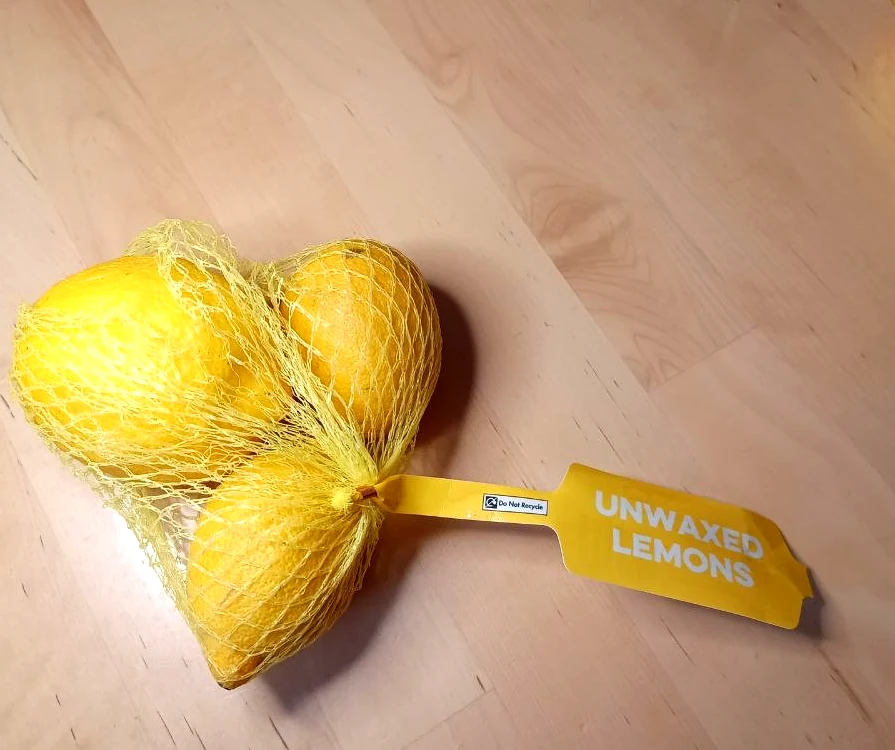
A reader asks: “I always buy unwaxed lemons and oranges to avoid chemicals. But does it actually make any difference, or am I just wasting my money?”
My answer: “Well, yes… in some ways. But perhaps not for the reasons you imagine”
Supermarkets and fruit suppliers certainly expect to make quite an impression when they write UNWAXED in big capital letters.But what does this really mean?
How do unwaxed citrus fruits compare with waxed ones or, on the other hand, with organic products?
Well, let’s see this and what choices we can make for better health.
First of All, What Are the Waxes Used on Citrus Fruits?
There are mainly four types, three of natural origin and one synthetic. They are generally poorly absorbed by the human digestive system.
Why are waxes used?
They are used as glazing agents, to reduce moisture loss, to prevent post-harvest shrinkage and… here comes the main problem… as a carrier matrix for fungicides.
Fungicides?
Yes, fungicides!
Basically, a specific group of pesticides applied either before or after harvesting, but commonly after harvesting, to lemons, limes, oranges and definitely grapefruits.
So you can already start to see that the problem is… not necessarily the waxes themselves… but the substances added alongside them.
So, does unwaxed mean fungicide-free?
Absolutely not!
Now, What Are These Fungicides?
There are several of them, and they raise a number of health concerns.
How do you know whether the citrus fruit you buy has been treated with them?
If you buy conventional citrus from a supermarket or another large distributor, there is a good possibility that fungicides have been used on the fruit.
Of course, this is different from buying directly from a farmer you know, who assures you that they don’t use them.
After all, post-harvest fungicides are particularly useful for large distribution chains, where citrus fruits are harvested, stored, transported to distribution centres, stored again at supermarkets and finally placed on the shelves.
During all this time, mould can develop, and fungicides are used to prevent that.
But at what risk?
If you look at the label of treated citrus fruit, you may read (if you have very good eyesight or a very good pair of glasses!) one or more of the following substances:
Imazalil (IMZ): One of the most common fungicides used to treat citrus after harvesting. It can act as an endocrine disruptor, meaning it may interfere with the body’s hormonal system. It may affect reproductive health, fertility and other functions controlled by these hormones. It has also been classified as “Likely to be Carcinogenic to Humans” by the US Environmental Protection Agency (EPA), following animal studies that identified increased tumour incidence. (like red meat, also classified as probably carcinogenic to humans… but that’s for another article)
Pyrimethanil: Laboratory tests have raised concerns about potential DNA damage and other toxic effects.
Fludioxonil: Laboratory tests have shown that it can damage kidney cells under certain experimental conditions.
Thiabendazole (TBZ): Animal studies suggest that it can interfere with thyroid function, potentially affecting the hormones that regulate metabolism, energy levels and growth. High doses may also interfere with normal foetal development, potentially causing birth defects and affecting reproduction.
2-Phenylphenol: Has produced urinary tract effects and tumours in certain animal experiments.
These substances are obviously highly regulated, but this does not make them harmless. They are biologically active chemicals deliberately designed to inhibit living organisms.
The latest research published in 2025 and 2026 has reported mutagenic responses and DNA damage under certain experimental conditions. These studies have also raised questions about not only the toxicity of each individual fungicide, but also the effects of exposure to several of them, since you’ll often find a mixture of these substances on citrus fruits.
That does not mean that the residues normally found on citrus will cause these effects in humans. But neither should we confuse compliance with a legal residue limit with the complete absence chemical health risks..
Research has also estimated that children receive greater exposure to fungicides relative to their body weight.
Other questions remain too. For example, what happens to our intestinal microbiome, immune regulation and chronic inflammatory processes? All these, as we are discovering, are at the basis of many health issues.
Since the Fungicides Are on the Peel, Why Should We Even Be Considering This?
It is true that most residues are concentrated in or on the peel, while the pulp normally contains much lower concentrations.
However, we shouldn’t forget what happens when we prepare citrus fruit.
First, Peeling
We normally peel the fruit with our fingers. Maybe we even enjoy seeing and feeling the essential oil glands bursting under the pressure of our hands. We see that little cloud of aromatic oils spraying from the peel…
But what might these oils carry with them?
Yes… fungicide residues.
Then, with the same fingers, we touch the pulp, and in doing so, we may transfer some of these substances onto the fruit we are going to eat.
Second, Squeezing
You may have one of those squeezers where you hold half a citrus fruit in your hand and press it against a hard cone.
However, if you squeeze citrus regularly, you may use a lever-operated machine that applies considerable pressure to the rind while squashing the half fruit against the metal cone. When you do this, some of the tiny oil glands in the peel can burst, releasing essential oils that may carry fungicide residues into the juice.

What About the UNWAXED Label?
Well, that’s the big distraction we started the article with.
As stated at the beginning, waxes are not a major health concern in themselves.
The concern may be that they are used alongside fungicides, helping to retain residues on the citrus rind and potentially making them more difficult to remove by washing (although washing doesn’t necessarily remove much of the pesticide residue anyway).
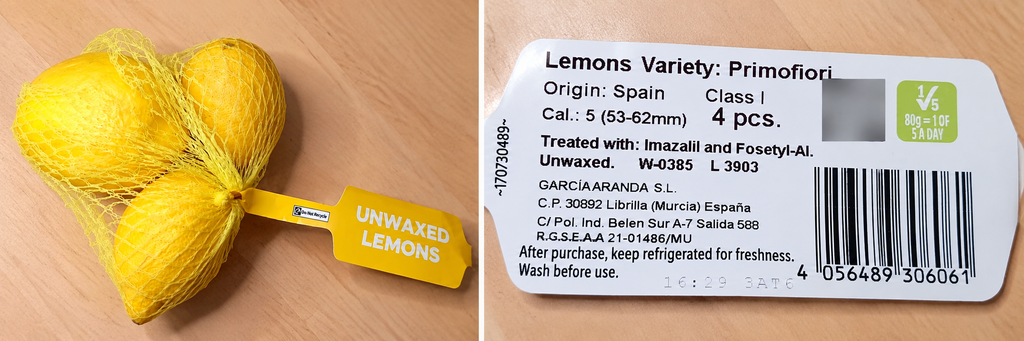
However, removing the waxing process does not mean removing the chemical treatment. An unwaxed lemon may still have received the same post-harvest fungicides. Meanwhile, the fungicide treatment may be declared in tiny letters, often on the back of the label, behind a massive UNWAXED statement.
What Should You Buy?
If you regularly use citrus zest in cooking (maybe to prepare cakes), make alcoholic infusions or marmalade, add lemon slices to drinks or, like me, enjoy eating the rind of fresh oranges (not the rind of those tired oranges we often find in supermarkets, of course!), the advice is quite simple:
Choose certified organic citrus whenever you can.
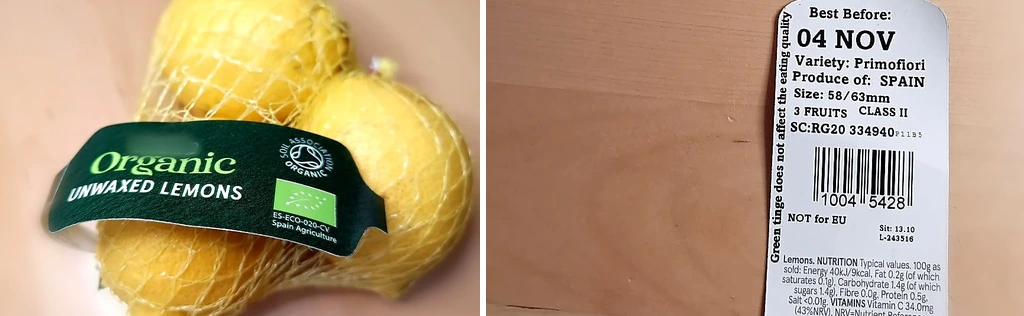
It is not a guarantee of zero pesticide residues, but it substantially reduces the likelihood of conventional post-harvest fungicide treatments.
And here’s a little tip: keep an eye out for organic citrus from Sicily! In 2024, around 28% of Sicily’s citrus-growing area was organic, and remarkably, the island alone accounted for 56% of all organic citrus-growing land in the EU!
Even better, if you can, buy directly from a producer who can confirm how the fruit has been treated.
Nothing can beat the flavour of a freshly picked orange, cut into pieces and eaten with the pulp and rind together!
OK… stop dreaming…
If you normally eat citrus by peeling it or squeezing it for juice, instead, wash it first with plenty of running water.
There is also some evidence that certain pesticide residues can be better removed by soaking fruit in a baking soda (sodium bicarbonate) solution.
Dissolve one teaspoon of baking soda in half a litre of water, submerge the citrus for 15–20 minutes, then gently scrub and rinse it under running water. This may remove some surface residues, although its effectiveness depends on the particular fungicide.
In any case, always read the label, especially the small bits of writing!
Don’t Be Embarrassed to Be a Food Snob!
People sometimes mock, or at least consider strange, those who read food labels carefully, question ingredients or choose more expensive alternatives because of their quality, considering them food snobs.
Well, maybe we need a few more food snobs!
Of course, there’s nothing admirable about being snobbish. But there’s every reason to take pride in choosing better food..
Not more expensive because of the place where we buy it, or the packaging, but more expensive because of the quality, safety and integrity of the food.
Wanting better food, which at times simply means selecting real food, is not pretentious. It is taking care of your health.
Food containing chemical contaminants may comply with regulations, but that doesn’t make it is harmless.
And a substance not yet proven harmful is not proven harmless.
So… look beyond the reassuring words printed in enormous letters… and pay attention to the substances reported in the smallest print.
Scientific References & Further Reading
- US EPA — Imazalil: Carcinogenicity and Toxicological Assessment
https://downloads.regulations.gov/EPA-HQ-OPP-2013-0305-0024/content.pdf - Tisza et al. (2025) — Genotoxic Effects of Citrus Fungicides and Their Mixtures
https://doi.org/10.3390/foods14071264 - Lányi et al. (2026) — Migration of Citrus Fungicides from Lemon Peel into Foods and Beverages
https://doi.org/10.1016/j.foodchem.2026.150490 - Yolci Omeroglu et al. (2022) — Effects of Orange Processing on Pesticide Residues
https://doi.org/10.3390/foods11233918 - Jin et al. (2016) — Imazalil, Gut Microbiota and Intestinal Inflammation
https://doi.org/10.1016/j.chemosphere.2016.06.105 - Wang et al. (2018) — Imazalil, Gut Microbiota and Intestinal Barrier Function
https://doi.org/10.1093/toxsci/kfx227 - Systematic Review (2026) — Pesticides, Gut Microbiota and Health
https://www.mdpi.com/2039-4713/16/2/41 - Agence BIO (2026) — Organic Sector in the European Union: Organic Citrus Cultivation in Sicily (p. 138)
https://www.agencebio.org/wp-content/uploads/2026/04/Organic-Sector-EU-2026.pdf